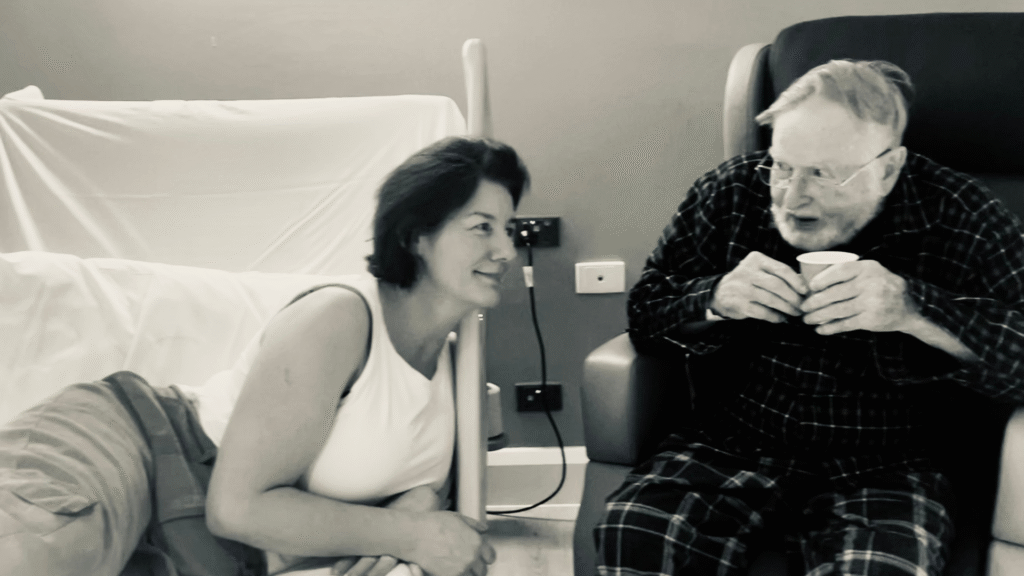
I’ve been trying to write this for weeks.
Grief is like that.
It clogs your brain while you’re standing in Coles staring at the biscuits.
It lets you joke with a friend one minute, then has you in tears in the car the next.
A month ago, I lost my father-in-law, Dave.
Except “father-in-law” doesn’t really describe what he was to me.
Not even close.
He was the person who debated the entire institution of marriage at our engagement dinner.
He was the person who thought knocking on the bedroom window was a charming way to announce his arrival.
He was the person who kept reading, questioning and challenging long after many people his age had stopped.
And over time, he quietly moved into the “dad” space in my life, without us ever naming it that.
So when he died, the grief that landed in my body did not match the title on the tin.
When the title and the relationship don’t match
I’ve chosen to have no contact with my biological father.
That decision is layered and painful and also right for me.
Which means for years, I’ve moved through life without a traditional “dad” role.
No Father’s Day text.
No “give me the phone, I’ll sort it” kind of person.
Dave never tried to replace that. But he did what he’s always done.
He showed up.
He asked big questions.
He argued about ideas.
He loved my kids.
He respected me.
So when he died, what I felt was not “oh, my father-in-law has passed away.”
It was “someone who became a parent-figure to me is gone.”
And that kind of grief can feel awkward to talk about.
Because the world has this invisible hierarchy of who gets to be the “main grievers”.
Partner. Children. Siblings.
If you’re the daughter-in-law, who felt “like a daughter”, or the neighbour who became family, people might assume your grief is smaller. Softer. Background.
But grief does not care about titles.
It cares about relationship and impact.
And sometimes the person whose name appears as “father-in-law” on the funeral brochure is the same person who took up the “dad” space in your nervous system.
That mismatch can leave you second-guessing yourself:
- Am I allowed to be this devastated?
- Do I make this about me?
- What if people think I’m overreacting?
If any of that sounds familiar, I want you to know this:
Your grief is not measured by your title.
It’s measured by your love.
Voluntary assisted dying and the countdown to goodbye
Dave died through voluntary assisted dying (VAD).
In NSW, VAD is now a legal option for eligible adults who have an advanced, progressive condition, are nearing the end of life, and are experiencing suffering they find intolerable. It is a medically supported process that allows a person to choose the timing and manner of their death within strict safeguards. (eldac.com.au)
I am deeply grateful he had that choice.
For a man who needed agency to feel authentic and secure, this mattered.
He didn’t want things to happen to him.
He wanted to decide.
So he did.
And I still believe it was the right decision.
At the same time, I’m not going to pretend it was easy to live with the countdown.
Knowing the date.
Clearing the calendar.
Telling clients I couldn’t see them, but not being able to say,
“Because someone I love is going to die on Friday at 10am, and my heart is already aching.”
There is something incredibly confronting about planning your life around a scheduled goodbye.
You still do the school run.
You still buy groceries.
You still answer emails.
But in the background there’s this quiet line running through everything:
He will not be here next week.
It is surreal, raw and, at times, absurd.
Grief inside a perimenopausal, neurodivergent nervous system
All of this is happening while my body is very much in the perimenopause chapter.
If you’ve read my “When Perimenopause Enters the Chat” blog, you’ll know this season has not exactly arrived gently. It has crashed through my sense of self, my hormones and my patience. (nestcounselling.com.au)
Add to that our very neurodivergent family system, with all the beautiful intensity that brings, and my nervous system often feels like a browser with 47 tabs open. One of them is playing music. I cannot find which.
Understanding Grief in Our Lives
So grief doesn’t just land as “sadness”.
It lands as:
- tears for no obvious reason
- forgetting words mid-sentence
- feeling overwhelmed by a single text message
- craving sensory quiet, while living in an actual family
There is no “standard” way to grieve, but hormones and neurodivergence can absolutely amplify everything.
Our kids also have neurodivergent diagnoses, something I’ve written about before in my 2024 reflections. (nestcounselling.com.au)
We already feel things deeply.
Transitions are often bigger.
Change is already hard.
So grief threads itself through our days in ways that are loud, quiet, sideways, delayed and sometimes accidentally hilarious.
Choosing to be there when he died
I chose not to be there when Dave died, waiting in the hall.
My husband and kids chose to be there.
We prepared.
We talked.
We checked in repeatedly that they wanted to be there and understood what that might mean, as much as any young person possibly can.
And then we did it.
They sat with him.
They held hands.
They watched someone we loved take their last breath through a process he chose.
It was tender.
It was sacred.
It was confronting.
There have been moments of overwhelm since. Of course there have.
Flashbacks. Big feelings. Tiredness. School being too much.
And yet, I still believe it was right for us.
To be inside the truth, not outside the door.
To show them that death can be honest and held, not always hidden and rushed.
If your grief doesn’t “fit”
If you’re grieving someone whose role in your life doesn’t match the label on the card, I want you to know:
- You are allowed to claim the fullness of your loss.
- You don’t need a legally correct title to justify how much it hurts.
- You can feel relief they are no longer suffering and deep sadness that they are gone.
- You can support their choice while still struggling with the reality of it.
If grief has cracked you open in unexpected ways, you’re not broken.
You’re human.
And if you’re in a season where hormones, trauma history and neurodivergence are all turned up to “extra spicy” while you grieve, you’re not too much.
You’re just carrying a lot.
You don’t have to do that alone.
If this resonates
If any of this feels close to home, you might also find these pieces supportive:
- “Better Late Than Never… My 2024 Reflections” – where I talk about neurodivergent diagnoses, injury, trauma and loss in our family. (nestcounselling.com.au)
- “When Perimenopause Enters the Chat: What It Means for Your Relationship” – for anyone whose hormones are making everything feel louder. (nestcounselling.com.au)
For information about grief and support in Australia, you might find these helpful:
- Grief Australia offers resources and support for people of all ages. (grief.org.au)
- The National Centre for Childhood Grief provides specialist services for children and their caregivers. (National Centre for Childhood Grief)
And if you would like a space to talk about your own grief, especially when it doesn’t fit neatly into a box, Nest is here.
You are welcomed and supported here.